Friday, May 10, 2013

Ahhhh! Sand and Foam

Forgive me if I indulge myself with this entry.  My wife Carol and I just returned from a week on Grand Cayman, where we ate, slept and went diving every day for a week.  We were the guests of our dear friends of many years, Pat and Howard Farr, at their time-share on Seven Mile Beach.

So, here goes.  Whenever we go to the Cayman Islands I have a little trouble getting in to the island's rhythm.  Here I am in black tee shirt, jeans and boots looking a little out of place--but I am smiling.
 
 
Carol on the beach.
 
 
The Man In Red
 
This photo, taken as the ocean was beginning to boil, inspired this bit of verse.
 
...out of Africa
 
We touched the rough cheek of Africa.
Tossed and turned in tumult, rocked in sleepless dreams,
Wind-blown and blue, hurried and unhurried in our time.
 
We called out to a man in red, knee deep in foaming, rumbling, sunset-surf, listening to his dream.
His dream is of tomorrow and he is resolute.
It is not his time.
Our time is forever,
And we returned to begin again our journey out of Africa.
 
 
The four of us learned to dive together in 1999, and here are some pictures of us taken by Howard and Carol underwater.
 
 
Pat and a school of French Grunts
 
 
There aren't too many pictures of Howard underwater because he is always behind the camera.
 
 
Pat and Howard on the right side of the lense this time.
 
 
Carol and I at Pallas Arches.  At the surface, after this dive, I nearly succumbed to sea-sickness once again!
 
 
What a dive can look like.  This is a drift dive and that is me in the upper left corner.  All four of us try to avoid the crowds.
 
What we see:
 
 
A Scorpion Fish.  Almost impossible to see among the coral.
 
 
A Southern Stingray.  The females are much larger than the males.
 
The USS Kittiwake was built in 1944, launched 10 July, 1945 and was a submarine rescue vessel.  It was the ship which found the space ship Challengers black box after it exploded during launch.
There are two decompression chambers on board as well a rack which held depth charges.  There are still mirrors in the bathroom and I wonder about the faces that have looked into them.
 
Kittiwake was sold to the Cayman Islands and was sunk to become an artificial reef and tourist attracion in January, 2011.  It rests in 63 feet of water.
 
 
Pat at the bow.
 
 
 Looks like the Titanic.
 
 
Me at the helm.  No one but me has ever done this.  Sure!
 
 
Pat ready to penetrate the Kittiwake.  We swam from stern to bow inside the ship.
 
 
Lucy, our English dive master, and Pat.  I believe Pat has told Lucy that she is low on air and Lucy is making the sign of the hull, indicating that Pat should go back to the dive boat,  Cool picture
 
Our good friends, Pat and Howard before dinner at the Lighthouse (it really was a lighthouse) on the east side of the island.  The water is much rougher on the east side and it is usually very windy.  It was blowing a gale on this evening and the surf was pounding the shoreline.
 
 
Sunset and Surf:


"This is the end.  My only friend, the end."
The End by The Doors.
 
And the beginning....


All photos by Howard Farr copyrighted 5/10/13
 
All photos by Carol Lang copyrighted 5/10/13
 
...out of Africa, copyrighted by Loren Schumacher 5/10/13
 
Copyright, Loren Schumacher 5/10/13


Wednesday, April 24, 2013

Damn it, Stormy!

Robert Miller, DVM, is best known for developing imprint training for newborn foals and as one of the early practioners of what is known as "natural horsemanship."  Several years ago at Road To The Horse, I questioned him about the horse's intelligence.  Horses have traditionally fared very poorly when compared to other barnyard animals such as the pig.  I said to him, "We both know how intelligent horses are, they learn easily and never forget anything or anyone, so why then do they score so poorly on intelligence tests?"  He told me, and I paraphrase, "Horses aren't reasoning animals, they're reactive because they are a prey animal.  Their first reaction is to flee or fight, one or the other.  Natural Horsemanship is based in part upon teaching a horse to use the reasoning side of its brain."

Well, we must have done a pretty good job with my mare, Stormy.  Our trainer says that he can see her thinking.  She has intelligent eyes that flash fire when she is angry and are liquid and gentle when she wants something...which is most of the time.

Stormy never pees in her stall, never.  Callie's stall, on the other hand, often looks and smells like the Dismal Swamp.  Lately though, Stormy's begun to pee right outside her stall as soon as I let her out in the morning.  There is a lot of it, and at the risk of being gross, let's just say that it doesn't smell a lot like Fabreeze.  To make matters worse, I like to spread her breakfast hay in front of the stall, right where she likes to pee.

So to encourage her to move away from the stall, I've started tapping the ground with my dressage whip, and it's worked reasonably well.  Still, there's been a lot of snorting and head tossing while her ears are pinned agains the sides of her head.  She's mad and she can't afford to be angry at me so she hazes Callie with nips and threats to kick.

Yesterday, whip in hand, I tapped and tapped the ground until a reluctant Stormy trotted toward the pasture, but abruptly turned on her hocks and headed for the remains of yesterday's hay lying on the ground near the stable.  I could tell she was pissed.  Her eyes were hooded and hard as flint, and I knew something, perhaps a "not good something," was going to happen.  I went into the feed room and emerged with a bucket in each hand.  I fed Callie and, skirting her stall door, saw Stormy standing in her stall waiting to be fed.  I also saw a river of pee snaking its way around and through her bedding as it flowed slowly, inexorably toward a depression in the floor where it formed a small but growing body of water.

So there you have it.  Stormy has shown an ability to reason and at the same time proven that she is intelligent and capable of initiating and executing a plan.  Oh, and she is also a vindictive witch.

Copyright, April 24, 2013

Monday, March 25, 2013

Fresh Horses

Recently I wrote a poem called: The Story, to honor a high school classmate who passed away.  It was the first I'd written in quite a while, but it prompted me to look at some of my old work.  Some of it is good, some not so good and some has proven to be just, well, trash.  But this one, Fresh Horses, still seems fresh as do a few others, which I will publish as time goes along.  I've always liked Fresh Horses and I hope you will too.


Fresh Horses
This string of horses is all that I own,
they keep me sane enough,
but mostly they keep me from being alone.
I watch their steamy breath when
the air snaps with cold,
and they nicker softly to me when the day's
"Hello" is told.
Their eyes grow wide and fearful
when my lasso's loosed to speak,
and they've thrown me to the ground, pitched me up
and down, so often that my brittle bones creak.
Still I listen for the music of their hooves
on rocky ground, and watch with pleasure
the joy they take in a dusty roll-around.
And if they weren't my living
I'd thank them for the best they were blessed to give,
and turn them loose with a tip of my hat and a wish to
live and let live.
Not all of my poems are about animals or cowboys, some are in blank verse and some are just nonsense.  No, I'm not the former Poet Laureate of the United States, Billy Collins, but I have fun with words.
Copyright, March 25, 2013


Friday, January 4, 2013

Sugar Is Sweet: A Little About Wyatt


As a two year old my first horse, Wyatt, a filly, already had a deep chest and powerful, rounded quarter horse haunches.  She was an unregistered bay, possibly a quarter/draft horse cross with a wide irregular blaze on her long face.  Whenever she came near, the other horses in the paddock gave way to Wyatt and the smallish dark bay paint with a bald face that shadowed her.  So dominant was she that the herd scattered even when their meager rations were dumped on the ground.  When Wyatt ate the little dark bay ate too.

Wyatt on the day, June 6, 2004 a 90+ degree day, that we bought her.
 
 
My wife, Carol, and I picked Wyatt and the little dark bay that became our horse, Callie, from among a restless herd of PMU  (Pregnant Mare Urine) fillies trucked nineteen hours from Manitoba to Ohio.  Premarin, a compound of estrogens, is derived from pregnant mare's urine and is used to treat postmenopausal symptoms,  The foals of these mares become a liability unless they can be sold to slaughter, auctioned or purchased by "rescue" operations as Wyatt and Callie had been.  While we may have saved Wyatt's life, it quickly became clear that she was a herd animal first and always.
 
Callie on the left and Wyatt in the center.  All three horses just isolated from the herd had been given a mountain of hay.  Callie obviously needed it.
 
Wyatt was restless and indifferent toward humans.  She performed lifelessly when longed and in the round pen would canter as if on autopilot, never looking in my direction.  She'd had virtually no contact with humans in her northern Manitoba home, so Wyatt was nearly as wild and untamed as any Mustang.  Our friend Kelly summed up the feelings of most of the barn staff when she said, "There are very few horses that I don't like, but Wyatt is one of them.  Someone just needs to ride the piss out of her until she straightens up."  But our investment in Wyatt slowly began to pay dividends, still, there were just a couple of things she seemed to really enjoy: the company of another horse and peppermints!
 
Once a horse was purchased it got all of the food it could eat. Wyatt, Callie and the hay pile.
 
 
One dark and rainy (really, it was!) October evening, Carol, Kelly and I took Wyatt into the barn's aisle to continue desensitizing her to my weight.  I was draped across her back, head down, rubbing her flanks and feeling her stagger under my weight when one of the barn regulars, a man, walked up, and without asking plopped a spearmint candy into Wyatt's mouth.  I saved my rant about barn manners and not feeding someone else's horse without first asking for the car ride home.
 
Not knowing this gentleman well, the conversation was strained, and soon the lapses in our talk grew uncomfortably long.  Saying, "See ya later," he left us.  As he disappeared down the aisle, Wyatt raised her head, and looking over her left shoulder, watched the receding figure intently.  After pausing to look at each one of us in turn, she dropped her head and let the spearmint candy slip from her mouth.  It fell to the concrete floor with a plastic click.  I'm sure that Wyatt was doing the horse equivalent of "ich" when she craned her neck as horses will, curled her upper lip, and snorted wetly.  I fished in my pocket and found what she was looking for, a peppermint.  While Wyatt crunched happily, the three of us were still laughing.
 
I love this picture and loved Wyatt, but...
 
we never got much closer than this.
 
 
Copyright January 4, 2013
All photographs by Carol A. Lang


Sunday, August 5, 2012

Notes for July 2012

Callie's new Soft Ride orthopaedic boots have arrived.  She's been some lame to plumb lame off and on for several months.  Our vet prescribed them and told us that her soles seem to be thin and that the problem is made worse by stomping flies and by her confirmation.  She is very deep chested and carries more weight on her front hooves than most horses.

Callie is not a difficult horse except when you ask her to actually do something, so she stepped into her new boots as though they were a pair of well-worn house shoes.  She made us laugh when she high-stepped across the pasture the first time but soon reverted to her normal foot dragging, stumbling gait, the one we know and love.

Stormy is on the verge of spinning and is learning more ranch horse moves.  Until she spins, my favorite will be the transition from a walk to a canter.  On her first try she took two steps before she cantered, and on the second try, well, I am predjudiced, but she was perfect.  She is a muscular little horse with a daisy-clipping gate, and when her mane flies and her flag is up her movement is almost breath-taking.

We sometimes call Stormy "Lefty," because when she is impatient (which is most of the time) she paws the ground with her left front hoof.  Here is a picture taken last fall when we appeared with Rick Lamb, host of The Horse Show, and Judy Reynolds, Phd. a nutritionist with ADM.  She's upset because we are standing around and there are cattle in the pastures behind the trees.  This segment appeared in June 2012 and will repeat in September.

We didn't sell tickets, but we used Stormy for pony rides in the heat of early July.  It was more than 95 degrees when my granddaughters, their mother, aunt and her four children came to our place for a "horse experience."  For more than two hours we rode Stormy, who weighs no more than 950 pounds, double, longed her with little kids aboard and led her with even smaller kids on her back.  She did it all without a complaint.  Her reward: lots of carrots, serious petting from the little ones and a shower from the garden hose, which she loves.  Callie watched it all with satisfaction from her stall while little hands and sticky fingers fed her carrots.  It's a hard life, Callie.


Here are my nine year old granddaughter, Annika, and her aunt riding Stormy.  That's me in my rag-pickers ensemble looking hot and tired.

I may be odd, but there is a peculiar, almost haunting beauty to a draught.  The air has a breathless, brittle quality like a bitter winter day.  There must be a name for the hard-edged cloudless blue sky, but if there is, I don't know it.  The grass, dry and sere, crackles under your feet like small gravel. The leaves yellowing in the heat flutter tiredly in a heat-driven breeze.  Our three Redtail Hawks scree as if they are calling out to their prey.  A new hatch of dragonfllies search for mosquitos on lacey, golden wings darting here and there in their primative way.  And fluttering butterflies stop for a moment, hoping to satisfy their need from withering purple and yellow flowers.  Our honey bees work the last clover blooms of summer. Callie munches absently on the leaves of a tree limb, broken and dangling after a thunderstorm.

Yes, it's dry and hot, oppressively muggy at times, and all the while I think how beautiful it is and how lucky I am to be part of it.

Loren

Copyright, August 5, 2012
All photographs by Carol A. Lang


Tuesday, July 3, 2012

Yesterday and Today


On this long ago Fourth of July the United States was a nation of farms, small towns, quiet crossroads, and main streets where businesses, and often people, succeeded or failed on their merits.  There were no bail outs and no social safety nets to fall back upon.

It was a time of high-button shoes, mutton-chop sleeves and dresses that reached nearly to the floor.  Only little girls could wear heat defying short dresses with long stockings.  Men suffered celluloid collars, ties, coats and fedoras even on the hottest days.  Little boys still did mischief and took a lickin' for it, went skinny dippin' and then chased after flag festooned wagons on sweltering July afternoons.

Often the only sounds to be heard were those of birds calling, or hoof beats on hard packed dirt roads, swearing teamsters on cobblestone streets, or the laughter of kids being kids.  So long as you weren't walking behind the plow you might hear music in the jingling brass harness fittings that the horses wore.  The soot streaked, thumping engines of industry were still married to the narrow streets of big cities.

We sometimes stare into space and dreamily imagine ourselves in those romantic days.  We see ourselves at church picnics and ice cream socials, barn dances or drinking sarsaparilla at the corner drugstore, and courting our best girl on a garden swing.

But life was hard, sometimes brutally hard, marked by large families, long days and short lives.  Medicine was "by guess and by golly" and women's sufferage and liberation were far in the future.  But for America, The United States of America, the future was at hand.  It was the time of American possibility and, like Carl Sandburg's "Chicago," we were a nation of the "Big Shoulders."

For the horses, every day was pretty much the same: too much work, too little rest and for most, a life which ended when their usefulness was done.  In large cities horses died in their traces and their bodies were left to rot in the streets.  They were a means to an end, as many chests and broad backs scarred by the whip or harness would attest.  Horses were truly beasts of burden, engines of both commerce and war, as well as the primary means of transportation.  So many horses died during the First World War that many in Europe thought the horse might become extinct.  We know that all of this is true because history tells us so, but I have many photographs in my collection that prove the love and affection people had for their horses, no matter how they were used.  In the golden age of the stern visage, some women allowed a warm, almost maternal smile while standing near or touching the taught, warm skin of their valued co-workers and friends, the horses.

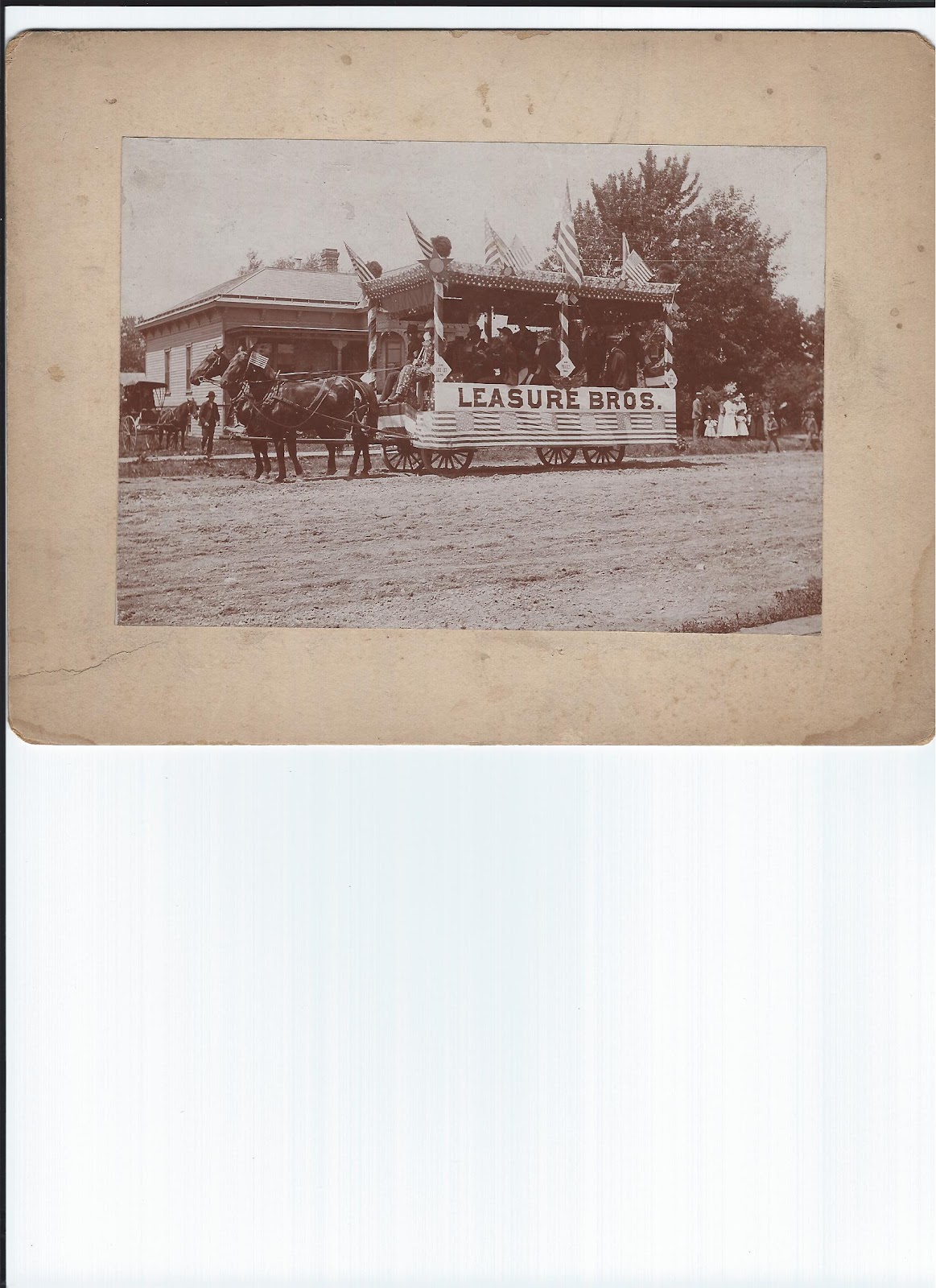
No one knows who the Leasure Brothers were or where they called home, but the photograph shown below from the 1890's assures us that they lived, and were patriotic.
"Our Prices Tell," the little sign in the wagon's middle reads.  What their prices said, we're not sure!

The horse's coats and harness shine and let us know that even in the Gay 90's, image was important.  Their ears tell us that the band in the wagon behind them must be playing a tune.  The conductor sits next to the driver and wears a white pith helmet and what can only be described as a garish suit of white squares on what seem to be trousers striped like the American flag.  We can see a fiddler and a double bass player on board as well, and I suspect the little boys following the wagon might be picking up pieces of candy thrown by the man standing in the rear.

Further to the right, a man in a straw boater and his daughter in a knee length dress and wide brimmed straw hat stand near a group of gossiping ladies in their long dresses.
He seems bemused at best and distracted at worst.  Perhaps his thoughts lean more toward a cool beer, clicking billiard balls, and the blue smoke of a dollar cigar.  We can never know.

Left of the horses is a man is forever caught in mid-step, his collar stud is fastened and his rolled brim slouch hat is pulled low over his eyes.  He is a working man, a man that on this bright, warm day also wears a coat.  To his right a man sits in the shade of his buggies convertible top, his horse is resting, and while its ears are alert, its head is held low.

On the farm the nation's birth was celebrated as well, but with a little less fanfare.  An older, Roman nosed plow horse does its patriotic double duty as a saddle horse and photo prop for two laughing children from a different time.  While it was unusual for adults to smile in pictures these two barefoot kids rejoiced in the moment and waved the flag.  The were the hope of the American Century, our century.

Much has changed since these photographs were taken: we live longer and in an urban society, and medicine, communication and transportation are far better.  Still, we are not the young, cock-sure, vibrant America of our past.  Too oftern we wait for the government to do for us what we can and should do for ourselves.  The curves in a country road make the journey interesting, yet in our zeal to be protected form every danger, we demand that the road be straightened and the adventure siphoned away like old oil.

Our country has more than its share of problems to be sure, but we still have the "Big Shoulders" and we should remember that.  This is still the greatest country on earth, and today, we celebrate her birth.

Happy Birthday, America.

Copyright, July 3, 2012
All photos from the author's collection


Tuesday, June 5, 2012

Had I been a baseball....

In a moment I went from standing at Callie's shoulder, putting fly spray on her face, to lying face down in the mud wondering if the next thing I would feel might be her crushing weight on top of me, or my being cut to shreds by her flailing hooves, or worse, a fatal blow to the back of my head as she struggled to stay on her feet.  All of those thoughts raced through my mind while I heard her hooves make dull, thudding noises in the mud around me, and then there was silence.  One of Callie's hooves had pinned the right leg of my shorts to the ground, her hoof coming down between my splayed legs.  I remember the silence that followed, and I always will.

When I got to my feet, Callie stood there looking at me with what I thought was both sorrow and fear in her eyes.  A quick check told me that I was ok, but I was covered in mud and nursing what was more than likely a bruised or jammed left shoulder.  The mud on my right calf told me all I needed to know about how close I had been to being seriously hurt.  I cradled Callie's head in my arms and tried to console her, telling her over and over that, "It's ok, girl, you didn't do anything wrong, I'm fine."

Over the past year or so the bond between Callie and I has grown, and my horse, Stormy, a dominant mare, has let it be known with pinned ears, flashing teeth, and the occasional threat to kick, that she is not pleased.

Callie's height partially blocked my view of Stormy as she approached, her head slightly lowered and her fly mask hiding her expression and her intent.  To be honest, I didn't give her a thought.  I've always been able to defuse Stormy's black moods with a word or hug, so I didn't pay much attention to her approach or her body language.  Stormy must have nipped Callie, who's first reaction was to flee.  She wasn't using the thinking side of her brain when she flattened me, she just wanted to get out of there.

Had I been a baseball, I would have been a line drive to left field, for sure a single and more likely a double to the wall.  There's little good to be said about over confidence, especially when dealing with thousand pound animals.  We forget that they have an emotional life just as we do and that that emotional being can quickly change from a friendly, loving companion to a jealous, aggressive beast.  Complacency and confidence can kill you.  How well I know.

(This happened on Sunday, June 3, 2012)

Loren

Copyright June 5, 2012